
Mistral is an advanced AI platform developed by Mistral AI, focused on delivering high-performance language models with an emphasis on efficiency and openness. Known for its lightweight yet powerful models, Mistral aims to provide fast, cost-effective AI solutions for developers and businesses. With a strong focus on open-weight models and flexibility, it has quickly become a notable alternative to more established AI providers.
Overview
Mistral is an AI platform developed by Mistral AI that focuses on creating high-performance and efficient language models. It is designed to provide fast, scalable, and cost-effective AI solutions for developers, businesses, and researchers.
The platform is known for its open-weight models, which give users more flexibility and control compared to fully closed systems. Mistral offers a range of models optimized for tasks such as text generation, reasoning, coding, and multilingual communication.
With a strong emphasis on performance and efficiency, Mistral aims to compete with leading AI providers while offering more accessible and customizable solutions. Overall, it serves as a powerful option for those looking to integrate advanced AI capabilities into their products and workflows.
How it Works
Mistral, developed by Mistral AI, provides access to powerful language models through APIs and developer tools. Users integrate these models into their applications or workflows by sending prompts (text inputs) to the system.
The AI processes the input using its trained models and generates responses such as text, code, or structured outputs. Different models can be selected depending on the task—for example, lightweight models for speed or more advanced ones for complex reasoning.
Mistral also supports open-weight models, allowing developers to run them locally or customize them for specific use cases. This gives more control over performance, privacy, and cost.
Overall, Mistral works as a flexible AI infrastructure, enabling users to build, customize, and scale AI-powered features in their products.
Comparison
Mistral differs from many AI platforms by focusing on efficiency, flexibility, and open-weight models. Unlike tools such as ChatGPT or Claude, which are mostly closed systems, Mistral allows developers to run and customize models more freely.
Compared to OpenAI, Mistral is more cost-effective and customizable, making it a good choice for developers and businesses that want more control. However, OpenAI generally offers more advanced features, better integrations, and a more polished experience.
When compared to Claude, Mistral prioritizes speed and lightweight performance, while Claude is known for more detailed and high-quality text generation.
Another key advantage of Mistral is its lower cost, especially for large-scale usage, while competitors may be more expensive.
Overall, Mistral is ideal for users who need flexible and affordable AI solutions, while other platforms are better suited for advanced capabilities and ready-to-use tools.
Features
Mistral offers a set of features focused on performance and flexibility. It provides powerful AI models of different sizes, allowing users to choose between faster lightweight models or more advanced ones for complex tasks like reasoning and coding.
One of its key advantages is the open-weight approach, which lets developers run and customize models locally, giving more control over data, privacy, and costs.
The platform supports multiple languages, making it suitable for global use, and can handle different types of tasks such as text generation, coding, and document processing.
Mistral also offers API access and developer tools, making it easy to integrate AI into applications and workflows. Additionally, users can fine-tune models to better match their specific needs.
Other features include support for long documents and advanced reasoning capabilities, making Mistral a flexible solution for building AI-powered products.
Use cases
Mistral is widely used for building AI-powered applications thanks to its flexibility and efficiency. Developers can integrate it into products for chatbots, virtual assistants, and customer support systems, enabling automated and scalable communication.
Businesses can use Mistral for content generation, including writing, summarization, and report creation, helping teams save time on routine tasks. It is also useful for data analysis and document processing, such as extracting information from large texts or generating insights.
In the tech space, Mistral is often used for coding assistance, helping developers write, debug, and optimize code. Its support for customization makes it suitable for creating industry-specific solutions, such as legal, financial, or healthcare tools.
Additionally, companies can deploy Mistral models locally for privacy-sensitive use cases, where data control is important.
Overall, Mistral is ideal for developers and organizations that need scalable, customizable, and cost-efficient AI solutions across different applications.
Price
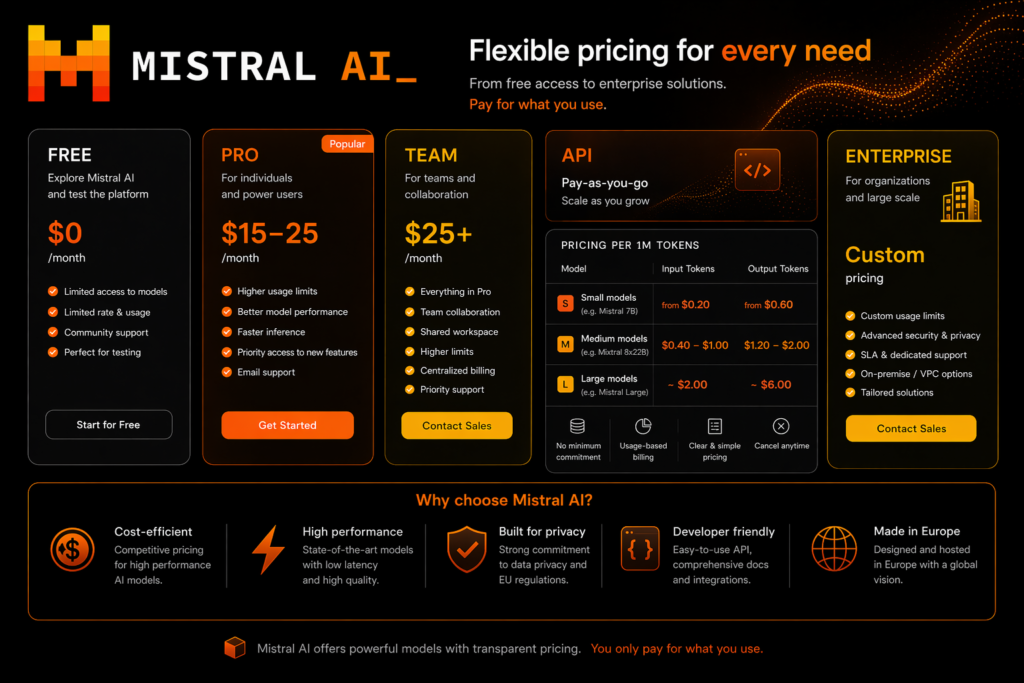
Mistral uses a flexible pricing system that includes both subscriptions and pay-as-you-go usage.
It offers a free tier with limited access, allowing users to test the platform. Paid plans usually start at around $15–25/month, providing higher limits and additional features.
For developers and businesses, Mistral mainly uses API-based pricing, where you pay based on the number of tokens processed. Smaller models are cheaper, while more advanced models cost more per usage.
There are also custom enterprise plans for companies that need higher limits, security, and support.
Overall, pricing depends on how much you use the models, making Mistral a cost-efficient option, especially for large-scale applications.
Final Verdict
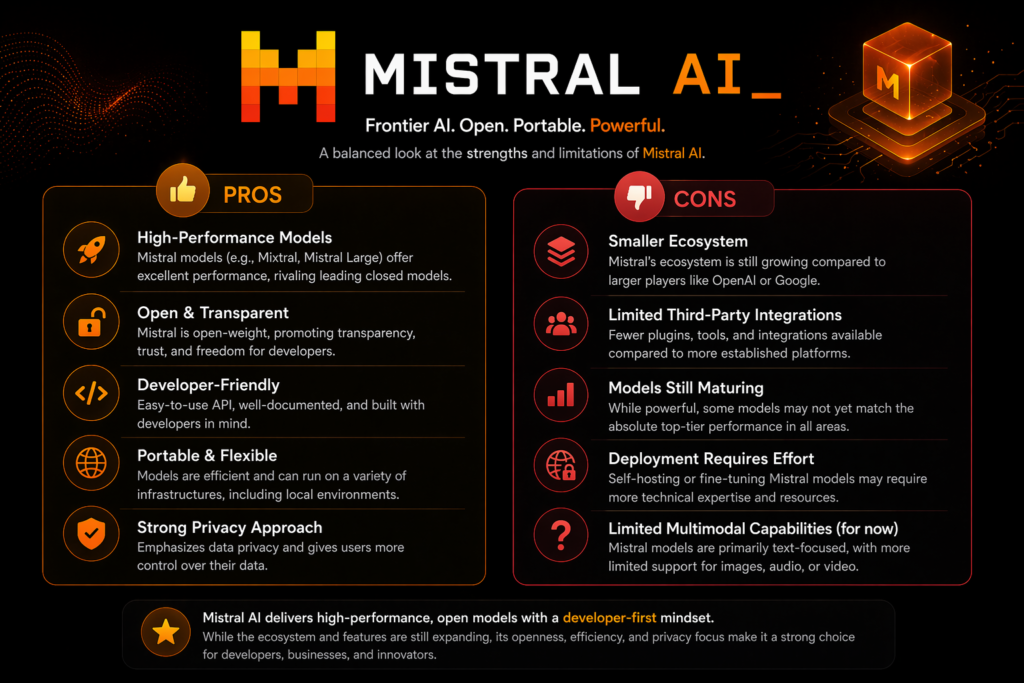
Mistral is a strong AI platform known for its efficiency, flexibility, and lower costs, making it especially appealing for developers and businesses. Its models deliver solid performance while remaining lightweight, which helps reduce expenses and improve speed.
A key advantage is its open and customizable approach, allowing users to run models locally and keep full control over their data—an important factor for privacy-focused projects.
However, it may not be as user-friendly as some competitors. The platform is more technical, with fewer built-in tools and integrations, and may require more setup and fine-tuning to get the best results.
Overall, Mistral is a great choice for users who value control, scalability, and cost efficiency, but it’s less suited for beginners looking for a simple, ready-to-use AI solution.